 Email Settings Guide
Quick answer: the Gmail IMAP server is imap.gmail.com on port 993 with SSL/TLS. The SMTP server is smtp.gmail.com on port 465 (SSL) or 587 (STARTTLS). The POP3 server is pop.gmail.com on port 995 with SSL. Sign in with your full Gmail address and an app password or OAuth, never your normal Google password.
What Changed Recently#
Related email providers: Outlook email settings, Yahoo IMAP settings, iCloud email settings, AOL IMAP settings, Mail.com email settings, CompuServe IMAP settings
Email providers change login rules more often than server addresses. Here is the current status for Gmail and what it means for your setup.
Latest update
Password only sign in is gone for good. Google retired Less Secure Apps, so your normal Google password no longer works over IMAP, POP or SMTP. Personal Gmail lost it in May 2022 and Google Workspace accounts were cut off on March 14, 2025. Use OAuth or an app password instead.
Earlier change
The IMAP on and off switch was removed. Google took the IMAP enable toggle out of Gmail settings. IMAP is on by default now, so for most accounts there is nothing to turn on before you connect an app.
Earlier change
App passwords now need 2-Step Verification. The app password page only appears once 2-Step Verification is on. If you cannot find it, that switch is almost always the reason.
Before You Begin#
Do these 2 things first. If you skip them, your email app will reject the connection even when every server value is correct.
1. Turn on 2-Step Verification
Without it, Google will not let you create an app password. The app password page also stays hidden. This is the single most common reason a Gmail setup stalls.
Where: myaccount.google.com → Security → 2-Step Verification
2. Pick OAuth or an app password
Your normal Google password will be rejected in every mail app. Modern clients sign you in through a Google window (OAuth). Older ones need a 16 character app password pasted in place of your password.
Where: App password steps below →
About Gmail#
Gmail is Google's free email service, launched in 2004 and used by roughly 1.8 billion people worldwide.
The servers themselves rarely change. What makes Gmail different from an old ISP mailbox is the sign in. Since Google retired Less Secure Apps, your account password only works on the Gmail website and Google's own apps. In Outlook, Apple Mail or Thunderbird you either approve a Google sign in window (OAuth) or paste an app password. That app password only exists once 2-Step Verification is on.
| Service Name | Gmail |
| Owned By | Google (Alphabet Inc.) |
| Launched | 2004 |
| Email Domains | @gmail.com, @googlemail.com |
| Webmail URL | mail.google.com |
| Protocols Supported | IMAP, POP3, SMTP |
| App Password Needed | Yes, for any client without OAuth |
| Free Storage | 15 GB, shared with Drive and Photos |
@gmail.com and the older @googlemail.com use the identical servers on this page. A Google Workspace address on your own domain uses the same servers too, but the admin controls differ. See the Google Workspace guide for those.
Gmail Webmail Login#
You can always read your mail in a browser. The official sign in pages are:
How Sign In Works#
IMAP is already on for most Gmail accounts, so there is no toggle to flip. The part that actually decides whether your app connects is the password. Gmail gives you two ways in. Your normal Google password is neither of them.
Option A: OAuth
The modern path. Your app opens a Google sign in window and you approve it. Google hands the app a token. You never type a password into the app. Recent Outlook, Apple Mail, the Gmail app and Thunderbird all support this.
Option B: App password
A 16 character code you generate once and paste in place of your password. Use it for older clients, scanners and scripts that cannot open a Google window. It needs 2-Step Verification on first.
Gmail IMAP Settings#
IMAP is the incoming protocol most people should use. It keeps your mail on the server so every device shows the same inbox.
| IMAP Server | imap.gmail.com | |
| Port | 993 | |
| Encryption | SSL/TLS (required) | |
| Username | Your full Gmail address, including @gmail.com | |
| Password | App password or OAuth. Never your normal Google password. | |
| Authentication | Required |
Gmail POP3 Settings#
POP3 downloads mail to 1 device. Pick it only if you want a local copy on a single computer. Not sure? See the comparison below.
| POP3 Server | pop.gmail.com | |
| Port | 995 | |
| Encryption | SSL/TLS (required) | |
| Username | Your full Gmail address | |
| Password | App password or OAuth |
Gmail SMTP Settings#
SMTP handles outgoing mail. If you can read mail but not send it, the problem is here.
| SMTP Server | smtp.gmail.com | |
| Port (SSL) | 465 | |
| Port (STARTTLS) | 587 | |
| Encryption | SSL or STARTTLS (required) | |
| Username | Your full email address | |
| Password | Same as incoming mail | |
| Authentication | Required. Check "My outgoing server requires authentication" in Outlook. |
Check Gmail IMAP Settings Online#
You don't need to download anything to check Gmail IMAP settings online. This page is the lookup: every value is verified, current and copyable straight from your browser. Not sure your address uses Gmail servers? Type it below and find out instantly.
Does my email address use these settings?
Runs in your browser only. Your address is never sent anywhere or stored.
Want to verify the account itself before configuring an app? Sign in at Gmail on the web, which confirms your address and password work, then confirm an app password exists. If both pass, any email app connects with the tables above.
Look Up IMAP Settings for Any Email Domain#
This page covers Gmail. For every other address, work email on a company domain included, we run a free online lookup database: imapsettings.com.
imapsettings.com
Complete email settings database, by Univik
Enter any email address and get the incoming and outgoing server settings for that domain in 1 step:
Your address is used only to find the settings for that domain. Nothing is stored or shared.
Gmail App Password Setup#
The most common setup failure is using the wrong password. Here is which one works where:
| Where you sign in | Regular password | App password |
|---|---|---|
| Gmail website and the Gmail app | ✓ Works | ✗ Not needed |
| Outlook, Apple Mail, Thunderbird | ✗ Rejected | ✓ Required |
| Phone mail apps (manual IMAP setup) | ✗ Rejected | ✓ Required |
| Clients with a Google sign in window (OAuth) | ✓ Works | Not needed |
How to Generate an App Password
- Open myaccount.google.com/apppasswords while signed in to your Google account.
- Turn on 2-Step Verification first if it is off. The app password page will not open without it.
- Type a name for the app, for example "Outlook" or "iPhone Mail".
- Select Create. Google shows a 16 character code in four blocks.
- Copy the code and paste it as the password in your email app. The spaces do not matter.
Set Up Gmail in Email Clients#
Where an app lists Google as a sign in choice, pick it and let OAuth handle the login. Only fall back to manual servers plus an app password when that choice is missing. Jump to your app:
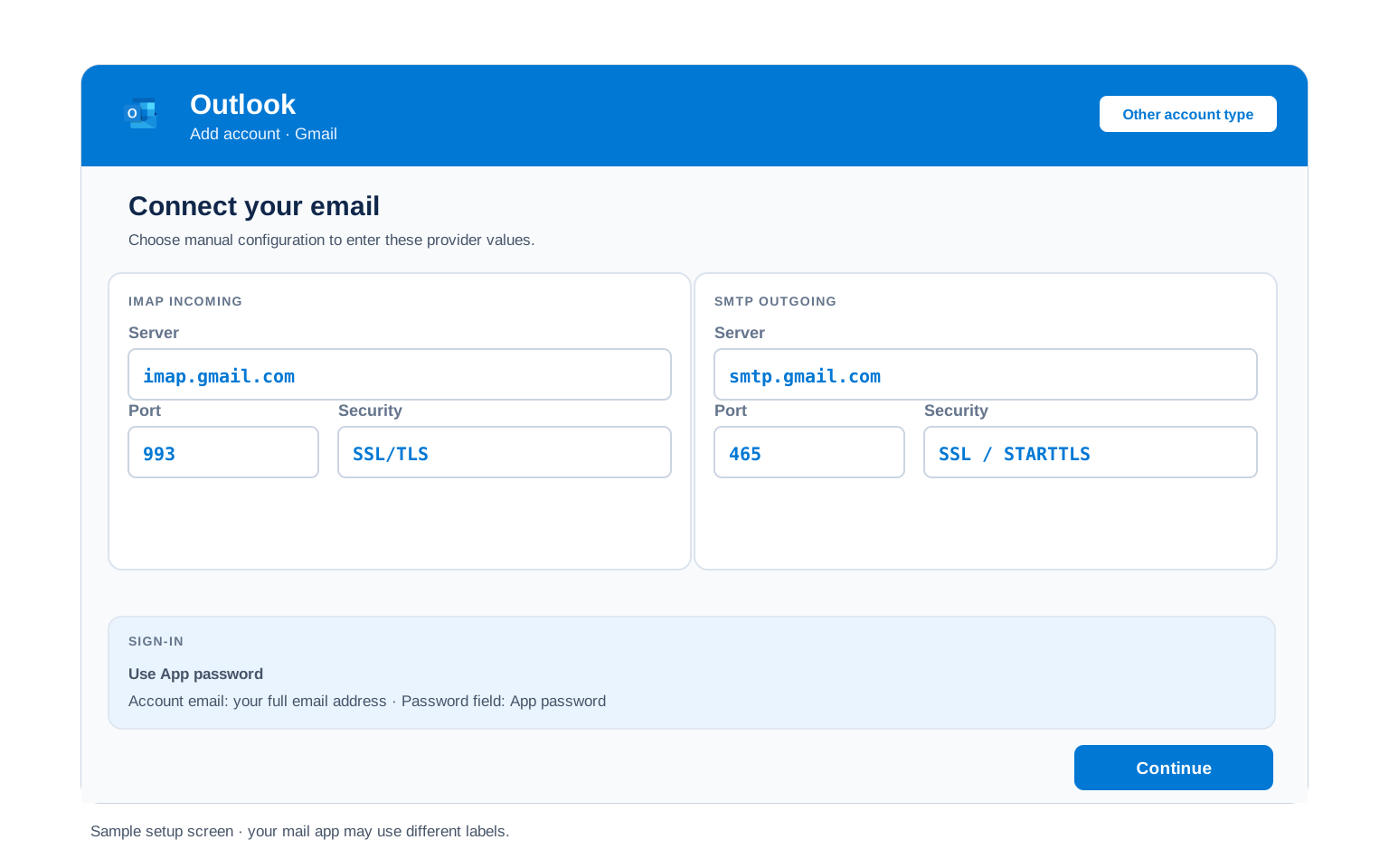
Outlook (Windows and Mac)
- Open Outlook → File → Add Account (in new Outlook, Settings → Accounts → Add account).
- Enter your Gmail address. New Outlook opens a Google sign in window, so approve that and you are done.
- For a manual IMAP account, open Advanced options, check "Let me set up my account manually", then choose IMAP.
- Enter the servers:
imap.gmail.comport993(SSL) andsmtp.gmail.comport587(STARTTLS), with a Gmail app password. - Finish and send a test email to yourself to confirm both directions work.
Apple Mail (macOS)
- Open Mail → Settings → Accounts → Add Account.
- Choose Google. A Google window opens and signs you in with OAuth, so no app password is needed.
- Approve the access request Google shows for Apple Mail.
- If you prefer a manual account, pick Other Mail Account and enter the table servers with an app password.
- Enable Mail in the checkbox list and finish.
iPhone and iPad
- Open Settings → Apps → Mail → Mail Accounts → Add Account.
- Tap Google. Safari opens Google's sign in, which uses OAuth, so no app password is needed.
- Sign in and approve the access request for iOS Mail.
- To set it up manually instead, tap Other, then Add Mail Account, keep IMAP and use the table servers with an app password.
- Tap Save and wait for iOS to verify the account.
Android
- Open the Gmail app → tap your picture → Add another account → Google. On Android this is native and uses OAuth.
- Sign in with your Google account. No server details or app password needed for the Google option.
- For a different app like Samsung Email, choose Other, then Manual setup, then IMAP.
- Enter the servers:
imap.gmail.com993 SSL incoming,smtp.gmail.com465 SSL outgoing, with an app password. - Finish setup and pull down to sync your inbox.
Thunderbird
- Open Thunderbird → Account Settings → Account Actions → Add Mail Account.
- Enter your name and Gmail address, then select Continue.
- Thunderbird detects the Gmail servers and offers OAuth2. Leave that selected and a Google window signs you in.
- If you chose manual setup, confirm IMAP, then
imap.gmail.com993 andsmtp.gmail.com465, with OAuth2 or an app password. - Select Done. Folders sync on first open.
Gmail Webmail Settings#
Server settings connect your apps. These settings control how Gmail itself behaves. All of them live in webmail under the gear icon, then See all settings.
Signature
See all settings, then the General tab, then Signature. Signatures set here appear in webmail only. Email clients like Outlook use their own signature settings.
Vacation Auto Reply
See all settings, then General, then Vacation responder. Set start and end dates so it turns off by itself. The reply works even when your computer is off because Gmail sends it from the server.
Filters and Folders
See all settings, then Filters and Blocked Addresses, then Create a new filter. Rules made here run on the server, so they sort mail before your phone or Outlook ever sees it. Client side rules only run while that app is open.
Spam and Blocked Senders
Open a message and choose Block sender. The Filters and Blocked Addresses tab handles many senders at once. Blocked mail goes straight to Spam rather than your inbox.
POP3 vs IMAP#
| Feature | IMAP | POP3 |
|---|---|---|
| Where mail lives | On the Gmail server | Downloaded to 1 device |
| Multiple devices | ✅ Everything stays in sync | ❌ Each device sees different mail |
| Sent and deleted mail | ✅ Synced everywhere | ⚠️ Stays only on that device |
| Offline reading | ⚠️ Cached mail only | ✅ Full local copy |
| Server storage used | Yes, counts against your quota | Can be freed after download |
| Best for | Phone + computer, everyday use | Single PC, local archives |
Gmail Sending and Storage Limits#
Hit a limit and Gmail blocks sending for up to 24 hours. Know the numbers before you bulk forward or migrate a mailbox:
| Emails per day (free Gmail) | 500 through a mail client |
| Recipients per message | 500 |
| Attachment size limit | 25 MB, larger files go as Drive links |
| Mailbox storage | 15 GB, shared with Drive and Photos |
| IMAP connections per account | 15 at once |
| What happens at the limit | Temporary 24 hour send block, error 550 5.4.5 daily quota exceeded |
Troubleshooting Gmail Connections#
Find the exact error your email app shows, then apply the fix:
| Error you see | What it means | Fix |
|---|---|---|
| Username and password not accepted | You entered your normal Google password | Gmail rejects it in apps. Set the account up with the Google (OAuth) option or paste a 16 character app password instead. |
| The app password page will not open | 2-Step Verification is off | Turn on 2-Step Verification first. The app password option only appears once it is on. |
| Cannot connect to server | Wrong port or encryption | Check IMAP 993 SSL and SMTP 465 or 587. Antivirus and VPN apps can also block these ports. |
| Deleting in the app also empties it from Gmail | IMAP deletes sync to the Bin | Deleted mail lands in the Gmail Bin and is purged after 30 days. Set your app to Archive instead of Delete or change where it moves deleted messages. |
| Messages stuck in Outbox | SMTP authentication is off | Enable "outgoing server requires authentication" with the same login as incoming mail. |
Reader Reported Fixes
Two fixes that come up again and again in Gmail setups, beyond the error table above.
Use the Google option instead of manual IMAP. People often fight app passwords on an iPhone or Mac when the built in Google choice signs in with OAuth in two taps and needs no code at all. If manual setup keeps failing, delete the account and pick Google.
Regenerate the app password after a password change. A common report is mail that worked for weeks then died overnight. It usually lines up with a Google password reset, which can void old app passwords. Generate a fresh one and paste it in.
Moving to Gmail?#
Gmail is usually the account people move to, not away from. Once your Gmail is set up with the servers above, bringing an old mailbox across is the next step.
Pull your old mail into Gmail. Gmail can import from another account under Settings, then See all settings, then Accounts and Import, then Import mail and contacts. It fetches your old messages over POP and keeps checking for a while.
Want a clean, folder by folder copy instead? The Univik Email Migration Tool copies every folder straight across. Enter your old account's IMAP settings on one side and imap.gmail.com with a Gmail app password on the other.
Closing the old account? Back it up first. Legacy ISP mailboxes are sometimes deleted after the service is cancelled and there is no recovery once that happens.
Rather not do it yourself? Our Email Migration Services team plans and runs the whole transfer for you and verifies every folder arrived.
Use These Settings in Univik Email Backup#
The same IMAP settings above let you download your complete Gmail mailbox to your computer. Univik Email Backup saves everything as PST, MBOX, EML or PDF files you keep forever, even if the account closes.
- Download Univik Email Backup and install it on Windows.
- Select Gmail from the source list. If it isn't listed by name, choose IMAP.
- Sign in with your full email address and your app password. Your regular password won't work here either.
- If the tool asks for server details, use
imap.gmail.comwith port993and SSL from the IMAP table above. - Pick a saving format and folder, then start the backup. Large mailboxes download in the background.
Univik Tools That Use These Settings#
Many people land here while migrating or archiving a mailbox. All 3 tools use the same IMAP settings from this page:

Email Backup
Download your complete Gmail mailbox to PST, MBOX, EML or PDF before switching or closing the account.
Email Backup Tool →
Email Migration Tool
Copy every folder from Gmail straight into Microsoft 365, Outlook or any other account. No manual export needed.
Email Migration Tool →
Email Converter Tool
Already have MBOX, EML or OST files from an old export? Convert them to PST, PDF or any format your new app opens.
Email Converter Tool →Prefer to hand the whole migration to experts?
If server settings and app passwords feel like too much, you don't have to learn them. Univik's migration team handles the complete project: planning, transfer, verification and a report showing every folder made it. Since 2013, for single mailboxes up to full company moves.
Email Settings Glossary#
IMAP
Internet Message Access Protocol. Reads mail that stays on the server, so all your devices see the same inbox, folders and read status.
POP3
Post Office Protocol version 3. Downloads mail to 1 device and can remove it from the server. Older method, still useful for local archives.
SMTP
Simple Mail Transfer Protocol. Sends your outgoing mail. Every account needs it next to IMAP or POP3, which only receive.
SSL / TLS / STARTTLS
Encryption for the connection. SSL/TLS encrypts from the start (ports 993, 995, 465). STARTTLS upgrades a plain connection (port 587).
App Password
A 16 character code that replaces your real password inside email apps. Safer because you can revoke 1 app without changing your main password.
OAuth
Sign in through the provider's own window instead of typing a password into the app. The modern method most providers are moving to.
How We Verify These Settings#
Univik builds email backup, migration and converter software since 2013. Our tools sign in to Gmail over IMAP and SMTP every day for thousands of users, so a changed server, port or login rule shows up in our connection logs before most guides notice it.
Every value on this page is confirmed with 3 checks: a live IMAP and SMTP connection from Univik Email Backup, a comparison against Google's official documentation and a fresh app password generated through the current account security flow. We re verify after any Google announcement and at least once a quarter.
Found something that no longer matches what Google shows you? Tell us and we will retest and update the page, with the change logged in what changed recently.
 Help & Support
Frequently Asked Questions
Incoming is imap.gmail.com on port 993 with SSL. Outgoing is smtp.gmail.com on port 587 with STARTTLS. Port 465 with SSL also works. Sign in with your full Gmail address and an app password or OAuth, never your normal Google password.
Google retired Less Secure Apps, so your account password no longer works over IMAP, POP or SMTP. The password is right, the method is blocked. Either sign in with the Google (OAuth) option or generate a 16 character app password and use that instead.
IMAP for almost everyone. It keeps your phone, computer and Gmail on the web in sync. POP3 fits only a single computer where you want a local download. It still needs turning on in Gmail settings first. Full comparison here.
For most accounts, no. Google removed the IMAP on and off switch, so IMAP is on by default and there is nothing to enable. POP is different: it still has a toggle under Settings, then See all settings, then Forwarding and POP/IMAP.
No. Google shows an app password only once. Delete the old one at myaccount.google.com/apppasswords and generate a new one. It takes under a minute and does not affect your other apps.
Yes, when you sign in with OAuth or an app password and keep 2-Step Verification on. Check the apps with access at myaccount.google.com now and then and remove any you no longer use.
An email client with IMAP downloads mail as it syncs, but a dedicated backup tool is faster and saves standard files you can open anywhere. See how to back up your Gmail mailbox. Google Takeout can also export your mail as an MBOX file, which an email converter turns into PST, PDF or whatever your new app opens.
Google retired password only sign in, which breaks setups that never changed on your side. Personal Gmail lost it in May 2022 and Workspace accounts on March 14, 2025. The fix is a new app password or moving the account to the Google sign in option.
An email migration tool copies mail directly between the 2 accounts over IMAP. You need the Gmail IMAP settings and an app password for this side, plus the same details for the destination account. Every folder, label and date stays intact.
If setting this up feels risky or you have many accounts to move, our managed email migration service does the entire job for you.
Other Email Provider Settings
Summary: Gmail Settings at a Glance
- IMAP: imap.gmail.com, port 993, SSL/TLS
- POP3: pop.gmail.com, port 995, SSL/TLS
- SMTP: smtp.gmail.com, port 465 or 587
- Username is your full Gmail address
- OAuth or an app password, never your Google password
- App passwords need 2-Step Verification on first
- Pick IMAP for phone and computer sync
- Sending limit: 500 emails per day on free Gmail