 Email Settings Guide
Quick answer: Sina Mail email runs on Sina Mail. Every protocol connects to imap.sina.com. IMAP is on 993, POP3 on 995 and SMTP on 465, each secured with SSL. Your username is the full address and the mailbox password you set in Sina webmail lets you in. Your exact values also sit under The Authorization Code in Sina webmail. Mail went missing? Check the deletion log.
What Changed Recently#
Related email providers: QQ Mail email settings, QQ International IMAP settings, NetEase 163 email settings, Sohu IMAP settings, 139.com email settings, 189.cn IMAP settings
A host changes how you sign in more often than it changes the server names. Here is the current status for Sina Mail and what it means for your setup.
Worth knowing
A client needs an authorization code. Sina no longer lets a client sign in with the login password. Generate a 16-character code in webmail and use it as the client password.
Worth knowing
The server follows the ending. A sina.com address uses the sina.com hosts and a sina.cn address uses the sina.cn hosts, so match the two.
Worth knowing
Turn the client service on first. POP3, IMAP and SMTP access is off until you switch it on in Sina webmail, so do that before setting up a client.
Before You Begin#
Handle these two basics before anything else. Skip them and your email app will reject the connection even when every server value is correct.
1. Create the mailbox
Add the address under your mail settings in Sina webmail and set its password. That password is the one your apps use.
Where: Sina Mail then your mail settings
2. Open the authorization code
Click the client code next to the address, then the authorization code to read the server name and secure ports.
Where: The Authorization Code
About Sina Mail#
Sina Mail is a long-running mail service from Sina, one of China's big web portals. Free addresses end in sina.com or sina.cn. They read in Outlook, Apple Mail or Thunderbird as well as in the Sina webmail. There is also a paid VIP tier on vip.sina.com.
Which server you enter follows the ending. A sina.com address uses the sina.com hosts. A sina.cn address uses the sina.cn hosts. Whatever the ending, a client signs in with a 16-character authorization code rather than the login password.
| Ending | Incoming | Outgoing |
|---|---|---|
| sina.com | imap.sina.com 993 (POP pop.sina.com 995) | smtp.sina.com 465 |
| sina.cn | imap.sina.cn 993 (POP pop.sina.cn 995) | smtp.sina.cn 465 |
| VIP | imap.vip.sina.com 993 | smtp.vip.sina.com 465 |
Sina Mail Webmail Login#
You can always read your mail in a browser. The official sign in pages are:
Sina Signs You In With an Authorization Code#
A Sina mailbox will not let a client sign in with your ordinary login password. Instead you turn on the client service in Sina webmail and pass an SMS check. Sina then hands you a 16-character authorization code. That code goes in the client password field. It is what lets Outlook or Apple Mail connect.
| Step | What to do |
|---|---|
| 1 | Sign in to Sina webmail and open the client POP, IMAP and SMTP settings |
| 2 | Turn on the POP3 or IMAP service, then confirm the SMS code |
| 3 | Copy the 16-character authorization code Sina shows |
| 4 | Paste it into the client as the password |
Sina Mail IMAP Settings#
IMAP is the incoming choice Sina Mail points most people to. Mail stays put on the server, so a laptop and a phone read one shared inbox. Pull the exact server name from the authorization code in Sina webmail.
| IMAP Server | imap.sina.com | |
| Port | 993 | |
| Encryption | SSL/TLS (required) | |
| Username | Your full email address, including @sina.com | |
| Password | Your mailbox password | |
| Authentication | Required |
Sina Mail POP3 Settings#
POP3 downloads mail to 1 device. Pick it only if you want a local copy on a single computer. Not sure? See the comparison below.
| POP3 Server | pop.sina.com | |
| Port | 995 | |
| Encryption | SSL/TLS (required) | |
| Username | Your full email address | |
| Password | Your mailbox password |
Sina Mail SMTP Settings#
SMTP handles outgoing mail. If you can read mail but not send it, the problem is here.
| SMTP Server | smtp.sina.com | |
| Port (SSL) | 465 | |
| Port (STARTTLS) | 587 | |
| Encryption | SSL or STARTTLS (required) | |
| Username | Your full email address | |
| Password | Same as incoming mail | |
| Authentication | Required. Switch on outgoing server authentication in the client. |
465 with SSL. Many home connections block port 25. Sina Mail also supports 587 and 26 if 465 is blocked. Confirm outgoing authentication is on.
Check Sina Mail IMAP Settings Online#
You don't need to download anything to check Sina Mail IMAP settings online. This page is the lookup: every value is verified, current and copyable straight from your browser. Not sure your address uses Sina Mail servers? Type it below and find out instantly.
Does my email address use these settings?
Runs in your browser only. Your address is never sent anywhere or stored.
Want to verify the account itself before configuring an app? Sign in at Sina Mail webmail, which confirms your address and password work, then confirm an authorization code exists. If both pass, any email app connects with the tables above.
Look Up IMAP Settings for Any Email Domain#
This page covers Sina Mail. For every other address, work email on a company domain included, we run a free online lookup database: imapsettings.com.
imapsettings.com
Complete email settings database, by Univik
Enter any email address and get the incoming and outgoing server settings for that domain in 1 step:
Your address is used only to find the settings for that domain. Nothing is stored or shared.
Username and Password#
Both come from the mailbox itself. The username is the whole email address and the password is the one you chose when you built the address in Sina webmail. A standard Sina Mail mailbox uses no authorization code.
Username is the full address
Type you@sina.com in full, with the part after the at sign. Sina Mail turns down a bare mailbox name.
Put that same address on both incoming and outgoing.
Password is the mailbox one
This is the webmail password you set under your mail settings in Sina webmail, not your Sina Mail client area login. Reset it there if an app keeps refusing it.
The two factor prompt in the Sina Mail client area guards billing, not the mailbox connection.
Set Up Sina Mail in Email Clients#
The servers and ports are always the same. Only the menus differ. Jump to your app:
Outlook (Windows and Mac)
- In Outlook select Add Account, then turn on manual setup under Advanced options.
- Choose IMAP and set incoming to
imap.sina.comon 993 with SSL. - Set outgoing to the same server on 465 with SSL.
- Enter the full address and mailbox password when Outlook prompts you.
- Send a test message to yourself to prove both paths.
Apple Mail (macOS)
- In Mail select Add Account, then pick Other Mail Account.
- Give your name, Sina Mail address and password, then continue.
- Enter imap.sina.com with SSL on incoming and outgoing.
- Keep the SSL ports so nothing sends in plain text.
- Save and wait for the mailbox to load.
iPhone and iPad
- In Settings open Mail, then tap Mail Accounts and Add Account.
- Tap Other then Add Mail Account and fill your details.
- Keep IMAP chosen and put imap.sina.com in both server boxes.
- Leave the secure ports iOS fills, since Sina Mail expects SSL.
- Tap Save and let iOS run its check.
Android
- Open your mail app and tap Add account, then Other or IMAP.
- Put in your address and password. Switch to manual setup if it stalls.
- For incoming use imap.sina.com on 993 over SSL.
- For outgoing use smtp.sina.com on 465 over SSL.
- Save and swipe down to fetch your mail.
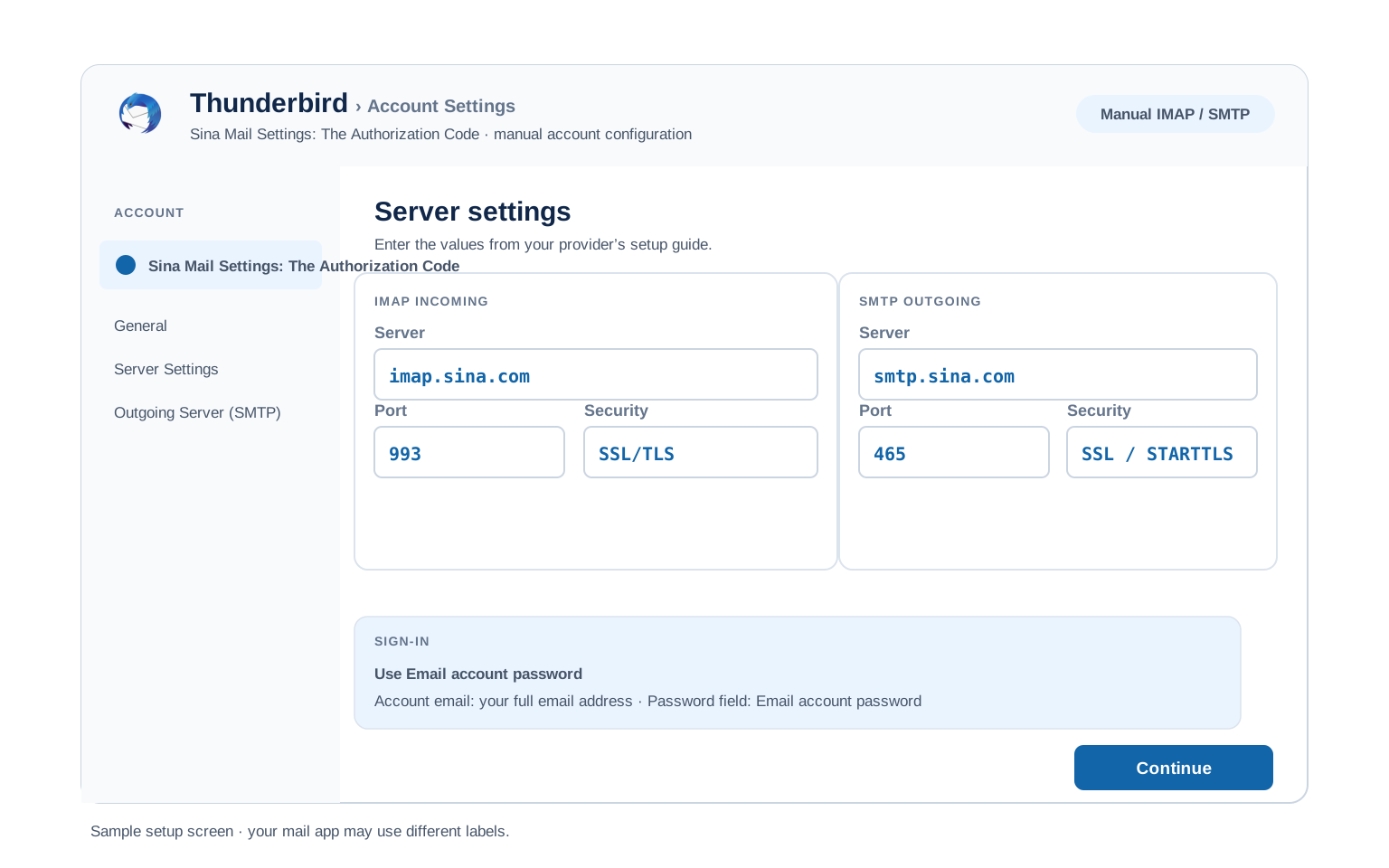
Thunderbird
- In Thunderbird pick Account Actions, then Add Mail Account.
- Type your name, Sina Mail address and password, then Continue.
- Wait for detection, then make sure IMAP with SSL is picked.
- If detection fails, type imap.sina.com in yourself.
- Hit Done and the folders fill in on the first sync.
Sina Mail Webmail Settings#
Server settings connect your apps. The controls here shape how the mailbox acts on its own. They live in the Sina webmail, opened in any browser.
Signature
Add one in the webmail preferences. It rides on mail sent from webmail. A desktop app keeps a signature of its own.
Vacation Auto Reply
Set an autoresponder in Sina webmail and give it start and end dates. The Sina Mail server delivers it, so it fires even when your machine is off.
Filters and Folders
Create filters from the Sina webmail filters in Sina webmail. A server side rule sorts a message ahead of any device fetching it. A rule set inside an app only works while that app is running.
Spam and Blocked Senders
Sina Mail runs SpamAssassin on incoming mail. Set the threshold and block unwanted senders in Sina webmail. Flagged mail lands in the junk folder for a look.
POP3 vs IMAP#
| Feature | IMAP | POP3 |
|---|---|---|
| Where mail lives | On the Sina Mail server | Downloaded to 1 device |
| Multiple devices | ✅ Everything stays in sync | ❌ Each device sees different mail |
| Sent and deleted mail | ✅ Synced everywhere | ⚠️ Stays only on that device |
| Offline reading | ⚠️ Cached mail only | ✅ Full local copy |
| Server storage used | Yes, counts against your quota | Can be freed after download |
| Best for | Phone + computer, everyday use | Single PC, local archives |
Sina Mail at a Glance#
Every value in one place. Match the host to your ending. Use the authorization code as the password:
| sina.com IMAP | imap.sina.com, 993, SSL |
| sina.cn IMAP | imap.sina.cn, 993, SSL |
| POP3 | pop.sina.com or pop.sina.cn, 995, SSL |
| SMTP | smtp.sina.com or smtp.sina.cn, 465 SSL (587 fallback) |
| Password | The 16-character authorization code |
| Client service | Turn on in Sina webmail first |
| Webmail | mail.sina.com.cn |
Troubleshooting Sina Mail Connections#
Find the exact error your email app shows, then apply the fix:
| Error you see | What it means | Fix |
|---|---|---|
| Username or password rejected | Short username or wrong password | Use the full email address with the mailbox password from Sina Mail, not the client area login. |
| Cannot send on port 25 | ISP blocks the default SMTP port | Switch outgoing to 465 with SSL. Sina Mail also accepts 587 and 26 if 465 is blocked. |
| Password rejected in the client | Using the login password | Sina wants the 16-character authorization code in the password field. Generate it in Sina webmail under the client POP, IMAP and SMTP settings, then paste it into the client. |
| sina.cn box will not connect | Wrong host for the ending | A sina.cn address does not use imap.sina.com. Set incoming to imap.sina.cn on 993 with SSL. Set outgoing to smtp.sina.cn on 465. |
| Cannot connect to server | Wrong port or encryption | Set 993 with SSL incoming and 465 with SSL outgoing. A firewall on your own machine can block it as well. |
| Repeated password prompt | Short username or a typo | Clear the saved login, then put in the full address with the mailbox password. |
| Messages stuck in Outbox | SMTP authentication is off | Enable "outgoing server requires authentication" with the same login as incoming mail. |
| Mail vanished after client setup | A client cleared it off the server | Open the Sina deletion log. If it shows client deletion, a mail app collected the message and removed it from the server. The message is inside that app, not lost, but it is gone from Sina. |
| Log says client deletion | App is not keeping a copy | Turn on the keep a copy on the server setting in that mail app. In Outlook it is in the account's advanced settings. New collections then leave the message on Sina for your other devices. |
Reader Reported Fixes
Copy from the authorization code. When a manual setup will not connect, the the authorization code page in Sina webmail prints the exact server name and ports for that mailbox. Pasting those in clears the guesswork behind most failed setups.
Test the login in webmail first. Sign in at webimap.sina.com with the full address and mailbox password. If webmail works, the credentials are right and the issue sits in the app settings.
Sina's Deletion Log Shows Why Mail Vanished#
When a message goes missing, Sina does not leave you guessing. The webmail keeps a deletion log that records why each message left the mailbox. Open it to see every removed message with its reason. The one to watch for is client deletion, which means a mail app pulled the message down and cleared it off the Sina server.
Client deletion happens when a POP or IMAP app collects mail without keeping a copy on the server. The message is safe inside that app, yet it is gone from Sina, so it will not show on your other devices. The log tells you which app did it. The fix is on the app side. In Outlook, open the account's advanced settings and tick the option to keep a copy of messages on the server. In other apps, look for a keep on server or keep a backup setting and turn it on.
| Log reason | What it means |
|---|---|
| Client deletion | A mail app collected the message and cleared it off the server |
| Deleted by you | The message was removed in webmail or a synced IMAP app |
| Spam rule | A filter or blacklist sent the message straight to deletion |
Moving Mail In or Out?#
Sina Mail mail speaks plain IMAP, so a mailbox moves in or out like any Sina account. Each folder stays on the server until the move finishes.
Take a copy first. Back up the mailbox before a move. A note that arrives mid switch can sit on either side. A copy keeps you safe.
Carrying mail across? The Univik Email Migration Tool moves each folder over an IMAP link. Give it the Sina Mail server name and mailbox password on this side and the other account opposite.
Rather hand it off? Our Email Migration Services team runs the whole move and verifies each folder arrived.
Use These Settings in Univik Email Backup#
The same IMAP settings above let you download your complete Sina Mail mailbox to your computer. Univik Email Backup saves everything as PST, MBOX, EML or PDF files you keep forever, even if the account closes.
- Download Univik Email Backup and install it on Windows.
- Select Sina Mail from the source list. If it isn't listed by name, choose IMAP.
- Give the complete email address with your mailbox password. The login name is always the whole email address.
- When the backup tool wants server details, hand it imap.sina.com on port 993 with SSL for Sina Mail. Take those values straight from the IMAP table above, with port
993over SSL. - Pick a saving format and folder, then start the backup. Large mailboxes download in the background.
Univik Tools That Use These Settings#
Many people land here while migrating or archiving a mailbox. All 3 tools use the same IMAP settings from this page:

Email Backup
Download your complete Sina Mail mailbox to PST, MBOX, EML or PDF before switching or closing the account.
Email Backup Tool →
Email Migration Tool
Copy every folder from Sina Mail straight into Gmail, Microsoft 365 or any other account. No manual export needed.
Email Migration Tool →
Email Converter Tool
Already have MBOX, EML or OST files from an old export? Convert them to PST, PDF or any format your new app opens.
Email Converter Tool →Prefer to hand the whole migration to experts?
If the hostnames and passwords feel like busywork, you can let the tool handle it. Univik's migration team handles the complete project: planning, transfer, verification and a report showing every folder made it. Since 2013, for single mailboxes up to full company moves.
Email Settings Glossary#
IMAP
Internet Message Access Protocol. Reads mail that stays on the server. Use imap.sina.com on 993 with SSL for a sina.com address. A sina.cn address uses imap.sina.cn.
POP3
Post Office Protocol version 3. Downloads mail to one device. Use pop.sina.com on 995 with SSL. A sina.cn address uses pop.sina.cn.
SMTP
Simple Mail Transfer Protocol. Sends your outgoing mail. Use smtp.sina.com on 465 with SSL and authentication. Port 587 is the fallback if 465 is blocked.
Authorization Code
A 16-character code that a client uses in place of your login password. You turn on the service and generate the code in Sina webmail.
Client Service
The POP3, IMAP and SMTP access for third-party apps. It is off by default, so switch it on in Sina webmail before a client can connect.
SMS Verification
Sina asks you to confirm a code by text to a bound mobile number before it shows the authorization code. Keep the phone to hand when you set up.
SSL
The encryption Sina needs. Turn SSL on, then set the ports to 993 for IMAP, 995 for POP and 465 for SMTP, so the connection stays private.
Full Email Address
Your username is the whole address, like you@sina.com or you@sina.cn. Type it in full on the incoming and the outgoing server.
sina.com and sina.cn
The two free Sina endings. A sina.com address uses the sina.com servers. A sina.cn address uses the sina.cn servers, so match the host to the ending.
VIP Mailbox
Sina's paid tier on vip.sina.com. A VIP address reads on imap.vip.sina.com and sends on smtp.vip.sina.com, its own host set.
Server Requires Authentication
The outgoing setting that signs you in. Tick it and use the same address and authorization code as for incoming mail.
Sina Mail
A long-running Chinese web portal mail service by Sina. Free addresses end in sina.com or sina.cn, read at the Sina webmail.
Deletion Log
A Sina webmail record of why each message left your mailbox. Open it when mail goes missing to see the reason behind every removal.
Client Deletion
A deletion-log reason. It means a POP or IMAP app pulled a message down and cleared it from the Sina server, so it is gone from your other devices.
Keep a Copy on the Server
The mail-app setting that stops client deletion. With it on, a collection leaves the message on Sina, so every device still sees it.
How We Verify These Settings#
Univik builds email backup, migration and converter software since 2013. Our tools sign in to Sina Mail over IMAP and SMTP every day for thousands of users, so a changed server, port or login rule shows up in our connection logs before most guides notice it.
Every value on this page is confirmed with three checks: a live IMAP and SMTP connection from Univik Email Backup, a comparison against the Sina Mail guides and a sign in with a real mailbox using the full address. We re verify after any provider announcement and at least once a quarter.
Found something that no longer matches what Sina Mail shows you? Tell us and we will retest and update the page, with the change logged in what changed recently.
 Help & Support
Frequently Asked Questions
For a sina.com address, incoming is imap.sina.com on 993 with SSL and outgoing is smtp.sina.com on 465. For a sina.cn address, use the sina.cn hosts. The username is your full address.
Sina does not let a client use your login password. It wants a 16-character authorization code that you generate in Sina webmail. Paste that code into the client password field instead.
Sign in to Sina webmail, open the client POP, IMAP and SMTP settings and turn the service on. Sina asks for an SMS confirmation, then shows a 16-character code. Copy it into your client.
Yes. POP3, IMAP and SMTP access for third-party apps is off by default. Switch it on in Sina webmail before a client can connect, in the same place you generate the authorization code.
A sina.cn address uses the sina.cn hosts. Incoming is imap.sina.cn on 993 with SSL. POP is pop.sina.cn on 995. Outgoing is smtp.sina.cn on 465, with the authorization code as the password.
Send on smtp.sina.com on 465 with SSL and authentication. If port 465 is blocked on your network, Sina supports 587 as a fallback. Turn authentication on with the same login as incoming.
IMAP is the better default. It keeps mail on the Sina server so a phone and a laptop show the same inbox. POP downloads to one device, which suits a single machine you back up yourself.
A Sina VIP address on vip.sina.com uses its own hosts. Incoming is imap.vip.sina.com and outgoing is smtp.vip.sina.com, both on the usual SSL ports, with the authorization code as the password.
Open mail.sina.com.cn and sign in with your full address and login password. The webmail is also where you turn on the client service and generate the authorization code.
A POP or IMAP app collected the mail and cleared it off the Sina server. Open the Sina deletion log to confirm. If the reason is client deletion, the message is inside that app but gone from Sina. Turn on the keep a copy on the server setting in the app so it stops happening.
Other Email Provider Settings
Summary: Sina Mail Settings at a Glance
- IMAP: imap.sina.com, port 993, SSL/TLS
- POP3: imap.sina.com, port 995, SSL/TLS
- SMTP: smtp.sina.com, port 465 or 587
- Username is always your full email address
- Sina mailbox on the Sina servers
- Pick IMAP for phone + computer sync
- Full address as the username
- Username is always the full email address