 Email Settings Guide
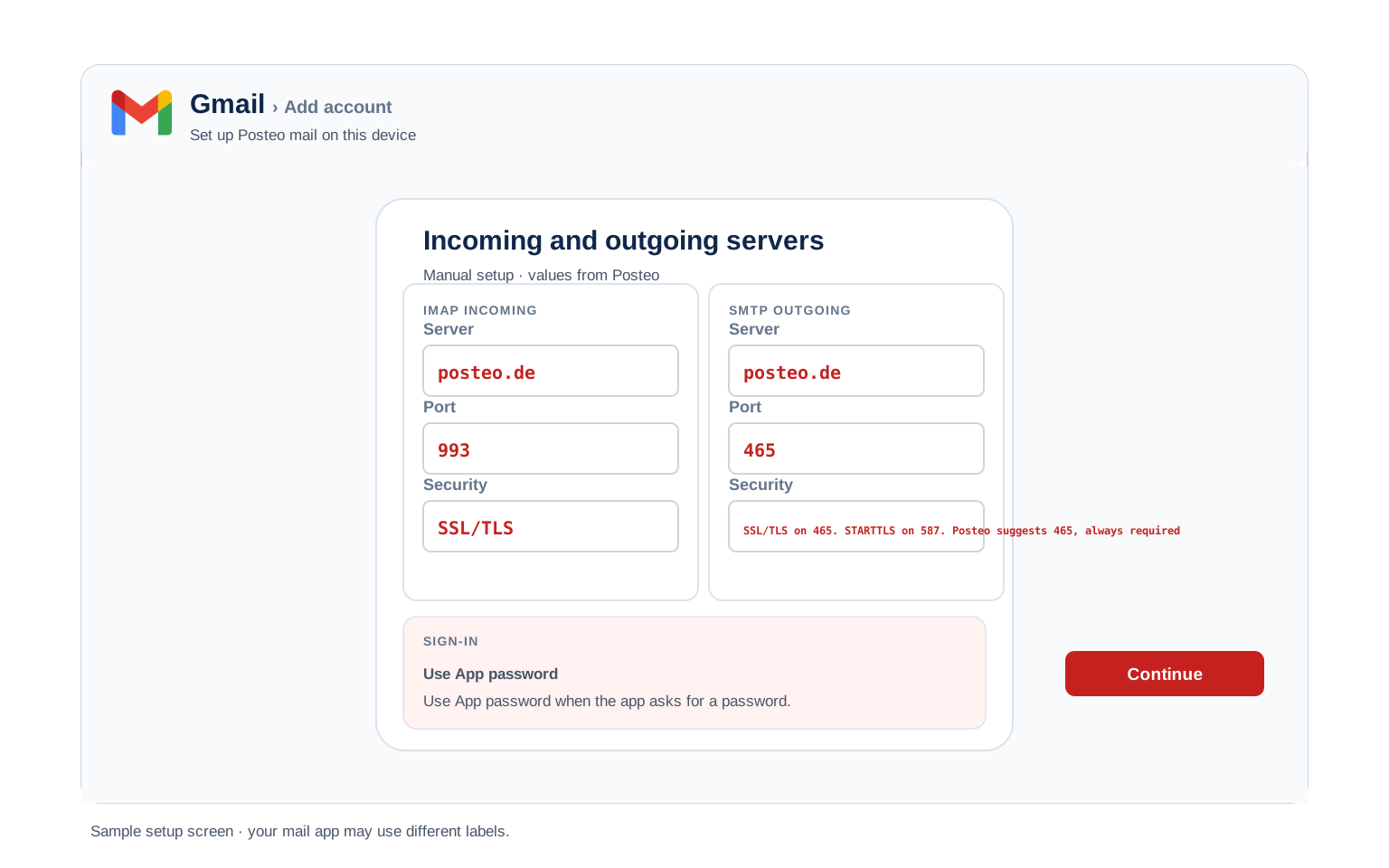
Quick answer: Posteo uses a single host, posteo.de, for every protocol. IMAP is port 993 with SSL/TLS, POP3 is 995, SMTP is 465. There is no imap.posteo.de or smtp.posteo.de, whatever some guides print. Sign in with a Posteo app password rather than your webmail password. Use your full address as the username. Posteo accepts encrypted connections only, so a client that cannot do modern TLS will not connect.
What Changed Recently#
Related email providers: Mailbox.org email settings, KolabNow IMAP settings, Mailo email settings, Proton Mail IMAP settings, Fastmail email settings, Hushmail IMAP settings
Posteo changes little, which is part of the point. The one moving piece is the encryption floor. It moves in one direction only.
Latest update
Obsolete TLS is refused outright. Posteo will not accept TLS 1.0, TLS 1.1 or anything older. If your email program only offers those, it cannot connect. Posteo support will point you toward an app that supports current encryption rather than lowering the bar. Update the client. Replacing it is the other option.
Earlier change
One host name for every protocol. IMAP, POP3 and SMTP all live at posteo.de. Guides that print imap.posteo.de or smtp.posteo.de are wrong. Entering those will fail to resolve. This has been stable for years and is unlikely to change.
Earlier change
Encrypted ports only, no plain fallback. Posteo has never offered unencrypted connections. There is no port 143 without STARTTLS and no plain POP3. If a client tries a plain port, the connection is refused rather than downgraded.
posteo.de with SSL/TLS, using a Posteo app password in your email client.
Before You Begin#
Two things to know before you start. Both are specific to how Posteo works.
1. Your client must support modern TLS
Posteo refuses plain connections and refuses obsolete TLS 1.0 and 1.1. An old app that cannot negotiate current encryption will not sync at all, which looks like a server fault but is not.
Where: Why this matters below →
2. Email clients need an app password
Your webmail password will not work in Outlook, Apple Mail or Thunderbird. Posteo asks you to create a separate app password and enter that instead. It takes a minute in your account settings.
Where: App password steps below →
About Posteo Mail#
Posteo is a paid, privacy focused email service run from Berlin, known for encryption, sustainability and taking no advertising money.
Setting Posteo up in a mail client is refreshingly plain in one respect and strict in another. Plain, because a single host name, posteo.de, serves IMAP, POP3 and SMTP alike, so there are no subdomains to get wrong. Strict, because Posteo accepts only encrypted connections and refuses obsolete versions of TLS outright. A modern client connects in seconds. An old one may not connect at all. That is deliberate.
| Service Name | Posteo Mail |
| Owned By | Posteo e.K., based in Berlin |
| Launched | 2009 |
| Email Domains | @posteo.de, @posteo.net and country variants such as @posteo.org |
| Webmail URL | posteo.de |
| Protocols Supported | IMAP, POP3 and SMTP, encrypted only |
| App Password Needed | Yes, for email clients. Up to five per account |
| Storage | 4 GB in the paid plan, up to 50 GB for a small monthly add on |
@posteo.de, @posteo.net, @posteo.org or another country variant, the server is posteo.de for all three protocols. The domain changes only the login, never the server.
Posteo Webmail Login#
Signing in from a browser is the fastest way to tell a wrong password from a wrong login name, since Posteo lets the two differ:
One Host, Encryption Only#
Two features define how Posteo connects. Both differ from the mainstream. Neither is a setting you toggle. They are how the service is built.
- One host name serves everything. IMAP, POP3 and SMTP all connect to
posteo.de. There are noimap.,pop.orsmtp.subdomains. Typing one will fail to resolve. - Only encrypted connections are accepted. Posteo has no plain text ports. Every protocol runs over SSL/TLS or STARTTLS. Nothing else is offered.
- Obsolete TLS is refused. A client that can only manage TLS 1.0 or 1.1 cannot sync. Posteo will not lower its encryption to accommodate old software, so the fix is always to update the client.
- Posteo recommends SSL/TLS over STARTTLS. Where your client offers both, choose the SSL/TLS ports, 993, 995 and 465. They connect encrypted from the first byte rather than negotiating up.
- There is no access switch to find. IMAP and POP3 are available by default. The settings below are the whole job.
imap.posteo.de as the incoming server. It has never existed. Posteo has always used the bare posteo.de for every protocol, which its own help confirms. If you copied imap.posteo.de from somewhere and it will not connect, that is why. Delete the prefix.
posteo.de, answers for IMAP, POP3 and SMTP. The imap. and smtp. prefixes some guides print do not exist.Posteo IMAP Settings#
IMAP is the incoming protocol most people should use. It keeps your mail on the server so every device shows the same inbox.
| IMAP Server | posteo.de | |
| Port | 993 | |
| Encryption | SSL/TLS (required) | |
| Username | Your full email address, including @posteo.de | |
| Password | A Posteo app password, not your webmail password | |
| Username | Your full Posteo address, domain included |
Posteo POP3 Settings#
POP3 downloads mail to 1 device. Pick it only if you want a local copy on a single computer. Not sure? See the comparison below.
| POP3 Server | posteo.de | |
| Port | 995 | |
| Encryption | SSL/TLS (required) | |
| Username | Your full email address | |
| Password | The same Posteo app password |
Posteo SMTP Settings#
SMTP carries outgoing mail on the same host, posteo.de. If you can read mail but not send it, the outgoing side is where to look. The usual cause is a client that filled in a plain port Posteo does not accept.
| SMTP Server | posteo.de | |
| Port (SSL) | 465 | |
| Port (STARTTLS) | 587 | |
| Encryption | SSL/TLS on 465. STARTTLS on 587. Posteo suggests 465, always required | |
| Username | Your full Posteo address | |
| Password | The same app password as incoming | |
| Authentication | Required. Check "My outgoing server requires authentication" in Outlook. |
Check Posteo IMAP Settings Online#
You don't need to download anything to check Posteo IMAP settings online. This page is the lookup: every value is verified, current and copyable straight from your browser. Not sure your address uses Posteo servers? Type it below and find out instantly.
Does my email address use these settings?
Runs in your browser only. Your address is never sent anywhere or stored.
Want to verify the account itself before configuring an app? Sign in at Posteo webmail, which confirms the account works and shows your exact login name. If the browser lets you in, any email app connects with the tables above.
Look Up IMAP Settings for Any Email Domain#
This page covers Posteo. For every other address, work email on a company domain included, we run a free online lookup database: imapsettings.com.
imapsettings.com
Complete email settings database, by Univik
Enter any email address and get the incoming and outgoing server settings for that domain in 1 step:
Your address is used only to find the settings for that domain. Nothing is stored or shared.
Posteo Password and App Passwords#
This is where most Posteo setups go wrong. It is where most guides get it wrong too. Posteo asks you to use an app password in email clients like Outlook, Apple Mail and Thunderbird, not the password you use to log in to webmail. The two are separate on purpose.
| Field | What to enter | Notes |
|---|---|---|
| Password in email clients | A Posteo app password | Created in your account, separate from your webmail password |
| Password for webmail | Your normal Posteo password | The app password will not log you in to webmail |
| Username | Your full Posteo address | Including the domain you registered, such as posteo.de, posteo.net or posteo.uk |
| Not sure which address | Settings, My account, Overview | Your username and login are shown there |
| Server | posteo.de for all three | Never imap.posteo.de or smtp.posteo.de |
How to Create a Posteo App Password
- Open Settings in Posteo webmail, then My account.
- Open Password and security and find the App passwords section, also called device passwords.
- Select Create app password. Your browser suggests a strong one that already meets Posteo rules.
- Name it after the device or app, for example Outlook laptop or iPhone Mail, so you can revoke the right one later.
- Enter your normal Posteo password to confirm, then save. Copy the app password now, because Posteo shows it only once.
Set Up Posteo in Email Clients#
Same host, posteo.de, in every client. Same encrypted ports. Only the menus differ. Pick your app:
Outlook (Windows and Mac)
- In Outlook choose File, then Add Account. New Outlook keeps this under Settings, then Accounts.
- Enter your Posteo address, open Advanced options and tick let me set up my account manually.
- Choose IMAP and enter
posteo.deon port993with SSL for incoming, thenposteo.deon port465with SSL for outgoing. - Enter your Posteo app password when Outlook asks, not your webmail password. If the login is rejected, check the username is your full address.
- Finish and send a test email to yourself to confirm both directions work.
Apple Mail (macOS)
- Open Mail → Settings → Accounts → Add Account.
- Choose Other Mail Account. Apple carries no Posteo entry among its providers.
- Enter your name, full address and Posteo app password, then continue.
- If asked for servers, enter the IMAP and SMTP values from the tables above.
- Enable Mail in the checkbox list and finish.
iPhone and iPad
- Open Settings → Apps → Mail → Mail Accounts → Add Account.
- Tap Other, then Add Mail Account. iOS has no Posteo option built in.
- Enter your details using your Posteo app password, then tap Next.
- Keep IMAP selected and fill the incoming and outgoing servers if iOS asks.
- Tap Save and wait for iOS to verify the account.
Android
- Open your mail app (Gmail app, Samsung Email or another) → Add account.
- Choose Other (IMAP) when your provider is not in the list.
- Enter your full address and Posteo app password. Where automatic setup fails, switch to Manual setup.
- Enter the servers:
posteo.de993 SSL incoming,posteo.de465 SSL outgoing. - Finish setup and pull down to sync your inbox.
Thunderbird
- Open Thunderbird → Account Settings → Account Actions → Add Mail Account.
- Enter your name, full address and Posteo app password, then select Continue.
- Check what Thunderbird detected. Confirm it chose
posteo.dewith SSL/TLS rather than any plain fallback. - If detection fails, choose Configure manually and enter the table values above.
- Select Done. Folders sync on first open.
posteo.de, both on SSL ports, with your Posteo login and account password.Posteo Webmail Settings#
Those values connect your apps. What follows shapes the mailbox itself. It lives in Posteo webmail rather than in any client.
Signature
Set from Posteo webmail settings. A signature added there shows on mail sent from the browser. Outlook and other clients keep their own, so the two can drift apart unless you match them by hand.
Vacation Auto Reply
Give the away message a start and an end date so it stops on its own. It runs on Posteo servers, so replies keep going out with every device switched off.
Filters and Folders
Rules built in webmail run server side, filing mail before any device downloads it. A rule inside Outlook fires only while Outlook is open, which is why two devices can disagree about where a message landed.
Spam and Blocked Senders
Block individual senders or whole domains from webmail. When mail goes missing, check the browser spam folder first, since a client side rule cannot pull back what the server already filed.
Sent for sent mail, Trash for deleted mail and Drafts for drafts. Pointing your client at these keeps webmail and your app in agreement about where each message lives.
POP3 vs IMAP#
| Feature | IMAP | POP3 |
|---|---|---|
| Where mail lives | On the Posteo server | Downloaded to 1 device |
| Multiple devices | ✅ Everything stays in sync | ❌ Each device sees different mail |
| Sent and deleted mail | ✅ Synced everywhere | ⚠️ Stays only on that device |
| Offline reading | ⚠️ Cached mail only | ✅ Full local copy |
| Server storage used | Yes, counts against your quota | Can be freed after download |
| Best for | Phone + computer, everyday use | Single PC, local archives |
Posteo Settings Worth Knowing#
Posteo publishes settings more readily than quotas. These are the points that actually shape a client setup:
| Server host | posteo.de for IMAP, POP3 and SMTP alike |
| Encryption | SSL/TLS or STARTTLS only. No plain ports |
| Minimum TLS | Modern only. TLS 1.0 and 1.1 are refused |
| App password | Used in email clients. Up to five per account |
| Username | Your full Posteo address, shown in account overview |
| Mailbox storage | 4 GB base, expandable to 50 GB |
Troubleshooting Posteo Connections#
On Posteo the causes cluster around two things: the single host and the encryption floor. Find your symptom, then the fix.
| Error you see | What it means | Fix |
|---|---|---|
| Server not found | imap.posteo.de or smtp.posteo.de was entered |
Those subdomains do not exist. Use the bare posteo.de for every protocol. |
| Cannot establish a secure connection | The client only offers obsolete TLS | Posteo refuses TLS 1.0 and 1.1. Update the client, since the encryption cannot be lowered to match it. |
| Login rejected, password looks right | The webmail password was used instead of an app password | Create a Posteo app password and enter that in the client. |
| Nothing connects after many quick retries | Some users report a short block after repeated failed attempts | Pause for a while, fix the app password on one client, then try that alone. This one is user reported, not stated by Posteo. |
| Cannot connect to server | Wrong port or encryption | Check IMAP 993 SSL and SMTP 465 SSL. Security software and VPN clients block these ports often enough to rule out. |
| Password keeps being asked | Webmail password used in a client | Clients need a Posteo app password. Create one and paste it as the password. |
| Messages stuck in Outbox | SMTP authentication is off | Enable "outgoing server requires authentication" with the same login as incoming mail. |
Reader Reported Fixes
Delete the prefix from a copied hostname. If you pasted imap.posteo.de from another guide, the connection fails to resolve. Change the incoming and outgoing server both to the bare posteo.de. That single edit fixes the most common Posteo setup complaint online.
If retries stop working, slow down and fix the password. A phone still holding an old password can hammer the server and, some users report, trigger a short block on external access. Remove the account from that device, create a fresh app password, then set the account up once. This block is user reported rather than documented by Posteo.
Moving to Posteo?#
People usually reach Posteo from a bigger free provider. The mail from that old account does not follow on its own. IMAP shows only what is on the server now, so years of archived mail stay behind unless you copy them across on purpose.
Set up the Posteo side with every value on this page. Server posteo.de, IMAP 993 with SSL, then your Posteo login. For the old account, use its own IMAP settings.
Copy the old mail over. The Univik Email Migration Tool copies every folder from the old mailbox into Posteo. Enter the Posteo IMAP details for the destination and the old provider details for the source, then let it run.
Keep a copy of your own. Before you close the old account, back it up. Once a free account is deleted there is usually no way to get the mail back.
Rather not do it yourself? Our Email Migration Services team plans and runs the whole transfer and checks that every folder arrived.
Use These Settings in Univik Email Backup#
The same IMAP settings above let you download your complete Posteo mailbox to your computer. Univik Email Backup saves everything as PST, MBOX, EML or PDF files you keep forever, even if the account closes.
- Download Univik Email Backup and install it on Windows.
- Select Posteo from the source list. If it isn't listed by name, choose IMAP.
- Sign in with your full Posteo address and a Posteo app password. If the login is rejected, check the address includes the right domain.
- If the tool asks for server details, use
posteo.dewith port993and SSL from the IMAP table above. - Pick a saving format and folder, then start the backup. Large mailboxes download in the background.
Univik Tools That Use These Settings#
Many people land here while migrating or archiving a mailbox. All 3 tools use the same IMAP settings from this page:

Email Backup
Download your complete Posteo mailbox to PST, MBOX, EML or PDF before switching or closing the account.
Email Backup Tool →
Email Migration Tool
Copy every folder from Posteo straight into Gmail, Microsoft 365 or any other account. No manual export needed.
Email Migration Tool →
Email Converter Tool
Already have MBOX, EML or OST files from an old export? Convert them to PST, PDF or any format your new app opens.
Email Converter Tool →Prefer to hand the whole migration to experts?
If server settings and app passwords feel like too much, you don't have to learn them. Univik's migration team handles the complete project: planning, transfer, verification and a report showing every folder made it. Since 2013, for single mailboxes up to full company moves.
Email Settings Glossary#
IMAP
Internet Message Access Protocol. Reads mail that stays on the server, so all your devices see the same inbox, folders and read status.
POP3
Post Office Protocol version 3. Downloads mail to one device and can remove it from the server. Older method, still useful for local archives.
SMTP
Simple Mail Transfer Protocol. Sends your outgoing mail. Every account needs it next to IMAP or POP3, which only receive.
SSL / TLS / STARTTLS
Encryption for the connection. SSL/TLS encrypts from the start (ports 993, 995, 465). STARTTLS upgrades a plain connection (port 587).
One host
Posteo uses a single server name, posteo.de, for IMAP, POP3 and SMTP. There are no imap. or smtp. subdomains to enter.
App password
A separate password you create for one device or app. Posteo uses these in email clients instead of your webmail password. You can hold up to five.
How We Verify These Settings#
Univik has built email backup, migration and converter software since 2013. Our tools sign in to Posteo over IMAP and SMTP every day for thousands of users, so a changed server, port or login rule shows up in our connection logs before most guides notice it.
Every value on this page is confirmed two ways: a live IMAP and SMTP connection from Univik Email Backup, then a line by line comparison against Posteo's own help pages. We re verify after any provider announcement and at least once a quarter.
Found something that no longer matches what Posteo shows you? Tell us and we will retest and update the page, with the change logged in what changed recently.
 Help & Support
Frequently Asked Questions
Use posteo.de on port 993 with SSL/TLS. That single host also handles POP3 and SMTP, so there is no imap.posteo.de. Sign in with a Posteo app password and your full address as the username. The full table is in the IMAP settings section.
The usual cause is using your webmail password in a client. Posteo wants an app password there instead. Create one, then paste it as the password. Also check the username is your full address including the domain. If you are unsure which address, it is shown under Settings, My account, Overview.
IMAP for almost everyone. It keeps your phone, computer and webmail in sync. POP3 suits a single computer where you want a local download, but on Posteo it deletes server mail by default, so turn on leave a copy first. Full comparison here.
Yes. The host posteo.de, the ports and the encryption never change between devices. Only the menus differ, which is what the client setup guides cover.
Yes. Posteo asks you to use an app password in email clients, kept separate from your webmail password. Create one under Settings, My account, Password and security. You can hold up to five. If you lose one, delete it and create another. Note that a forgotten password reset wipes all app passwords, so you would then recreate them.
Yes. The connection is encrypted on ports 993 and 465. Posteo refuses anything weaker. Because each client uses its own app password, a lost or stolen device is easy to cut off: delete that one app password and the rest keep working.
An email client with IMAP downloads mail as it syncs, but a dedicated backup tool is faster and saves standard files you can open anywhere. See how to back up your Posteo mailbox. If you already exported files in another format, an email converter changes them to PST, PDF or whatever your new app opens.
On Posteo the usual cause is the encryption floor. Posteo dropped support for obsolete TLS 1.0 and 1.1, so an old client that once worked can suddenly fail to connect. Check what changed recently. The fix is almost always updating the email app to one that speaks modern TLS.
An email migration tool copies mail directly between the two accounts over IMAP. You need the Posteo IMAP settings and a Posteo app password for this side, plus the same details for the destination account. Every folder and date stays intact.
If setting this up feels risky or you have many accounts to move, our managed email migration service does the entire job for you.
Other Email Provider Settings
Summary: Posteo Settings at a Glance
- IMAP: posteo.de, port 993, SSL/TLS
- POP3: posteo.de, port 995, SSL/TLS
- SMTP: posteo.de, port 465 or 587
- Username: your full email address
- One host,
posteo.de, for every protocol - Pick IMAP for phone + computer sync
- Encrypted ports only, obsolete TLS refused
- Email clients need an app password