 Email Settings Guide
Quick answer: the T-Online IMAP server is secureimap.t-online.de on port 993 with SSL/TLS. The outgoing server is securesmtp.t-online.de on port 465 with SSL. Port 587 with STARTTLS works too. The POP3 server is securepop.t-online.de on port 995. Your username is the full t-online.de address. The password is the part that catches people: Telekom issues a separate password for email programs. The one you use to sign in to the Kundencenter is refused here.
What Changed Recently#
Related email providers: Freenet email settings, Strato IMAP settings, A1 email settings, Bluewin IMAP settings, Infomaniak email settings, GMX IMAP settings
T-Online has kept its hostnames steady for years. The credential rules are where the change happened.
Latest update
Email programs need their own password. Telekom separates the account password, which opens the Kundencenter and the E-Mail Center in a browser, from a dedicated password for email programs. Outlook, Thunderbird, Apple Mail and phone mail apps all need the second one. Telekom describes the split as a security measure, so that a compromised mail client cannot reach the wider Telekom account.
Earlier change
Unencrypted connections are gone. The old plain ports no longer accept connections. Every hostname on this page begins with secure, which doubles as a reminder. An old configuration on port 143 or 110 will fail with what looks like a server fault.
Earlier change
The service has been Telekom Mail since 2013. The rebrand never displaced the @t-online.de address, which is what people still recognise and what every setting on this page refers to. Guides that call it Telekom Mail and guides that call it T-Online are describing the same mailbox.
Before You Begin#
Two things to settle before the server values. The first is the reason most T-Online setups fail.
1. Get the email program password
Telekom keeps two separate passwords. The one that opens your Kundencenter will not work in Outlook or Thunderbird. You need the dedicated password for email programs.
2. Use the encrypted ports
Every T-Online host carries a secure prefix for a reason. Plain unencrypted ports are no longer accepted, so 993, 995 and 465 or 587 are the only options.
Where: Server tables below →
About T-Online Mail#
T-Online is Deutsche Telekom's mail service, one of the largest in Germany and often chosen for the data protection standards that come with a German provider.
The service launched in 1995 as Deutsche Telekom's internet provider with email attached, was spun off as T-Online International AG in 2000, then folded back into the parent. Telekom renamed it Telekom Mail in 2013, though almost nobody calls it that and the @t-online.de address carried on regardless. The one thing that separates T-Online from most providers is the credential. Telekom gives you two passwords and expects you to know which is which.
| Service Name | T-Online Mail |
| Owned By | Deutsche Telekom AG |
| Launched | 1995, rebranded Telekom Mail in 2013 |
| Email Domains | @t-online.de and @magenta.de, on free and paid accounts alike |
| Webmail URL | email.t-online.de |
| Protocols Supported | IMAP, POP3, SMTP, on encrypted ports only |
| App Password Needed | Yes, always. Telekom calls it the password for email programs |
| Free Storage | 1 GB on Telekom Freemail. The paid Mail M package raises it to 15 GB |
@magenta.de as a second domain, which it presents as a companion to the t-online.de one rather than a replacement. Existing t-online.de addresses stay exactly as they are. A magenta.de address uses the same servers on this page.
T-Online Webmail Login#
The browser is the one place your Telekom account password works. These are the official pages:
Webmail
Account Security
Password Recovery
Which Password Does T-Online Want?#
This is the section to read if nothing else on the page gets read. Telekom maintains two separate passwords for one mailbox. Using the wrong one produces an error that looks exactly like a typing mistake.
- Password one, your Telekom account password. This opens the Kundencenter and the E-Mail Center in a browser. It is the password you probably think of as your T-Online password.
- Password two, the password for email programs. Telekom issues this separately. It is what Outlook, Thunderbird, Apple Mail and your phone must send over IMAP, POP3 and SMTP.
- They are not interchangeable. The account password is refused by the mail servers. No amount of retyping helps, because the credential is correct for a different door.
- Telekom did this deliberately. The split means a mail client that gets compromised cannot reach your wider Telekom account, which holds rather more than email.
- Everyone finds this confusing at first. A Telekom staff member had to explain it to a customer on Telekom's own community forum. The customer's reply, that two passwords for one mailbox remained confusing, is the standard reaction.
T-Online IMAP Settings#
IMAP is the incoming protocol worth choosing. Messages remain on the server, which is how every device ends up showing one inbox.
| IMAP Server | secureimap.t-online.de | |
| Port | 993 | |
| Encryption | SSL/TLS (required) | |
| Username | Your full email address, including @t-online.de | |
| Password | Your password for email programs, not the Kundencenter one | |
| Authentication | Required |
T-Online POP3 Settings#
POP3 brings mail down onto one machine. Worth choosing for a single computer keeping a local copy, rarely otherwise. Torn? The comparison follows.
| POP3 Server | securepop.t-online.de, written securepop3.t-online.de in some Telekom documentation | |
| Port | 995 | |
| Encryption | SSL/TLS (required) | |
| Username | Your full email address | |
| Password | The same email program password |
securepop.t-online.de and securepop3.t-online.de. Either works, which is worth knowing if you are comparing two guides and assuming one made a typing error. As always with POP, tick "leave a copy on the server" unless you are certain you want the server copy emptied onto one computer.
T-Online SMTP Settings#
secure. That is not decoration. Unencrypted connections are no longer accepted, so ports 143 and 110 will not answer whatever else you configure. Use 993 for IMAP, 995 for POP3, then 465 or 587 for outgoing mail.
SMTP carries outgoing mail. Reading fine while sending fails points here, though on T-Online a wrong password stops both directions at once rather than one.
| SMTP Server | securesmtp.t-online.de | |
| Port (SSL) | 465, the usual choice | |
| Port (STARTTLS) | 587, an equally valid alternative | |
| Encryption | SSL or STARTTLS (required) | |
| Username | Your full email address | |
| Password | Same as incoming, the email program password | |
| Authentication | Required. Outlook labels this the outgoing server authentication tickbox. |
Check T-Online IMAP Settings Online#
You don't need to download anything to check T-Online IMAP settings online. This page is the lookup: every value is verified, current and copyable straight from your browser. Not sure your address uses T-Online servers? Type it below and find out instantly.
Does my email address use these settings?
Runs in your browser only. Your address is never sent anywhere or stored.
Want to verify the account itself before configuring an app? Sign in at T-Online webmail, which confirms your address and password work, then confirm an app password exists. If both pass, any email app connects with the tables above.
Look Up IMAP Settings for Any Email Domain#
This page covers T-Online. For every other address, work email on a company domain included, we run a free online lookup database: imapsettings.com.
imapsettings.com
Complete email settings database, by Univik
Enter any email address and get the incoming and outgoing server settings for that domain in 1 step:
The address is inspected in your browser to work out the domain. It goes no further.
Creating Your T-Online Email Program Password#
Telekom sets this up in the Kundencenter, where you sign in with the other password. Here is which credential belongs where:
| Where you sign in | Telekom account password | Email program password |
|---|---|---|
| Telekom Kundencenter | ✓ Works | ✗ Wrong door |
| E-Mail Center in a browser | ✓ Works | ✗ Wrong door |
| Outlook, Apple Mail, Thunderbird | ✗ Rejected | ✓ Required |
| Phone mail apps, backup and migration tools | ✗ Rejected | ✓ Required |
How to Create the Email Program Password
- Sign in to the Telekom Kundencenter using your Telekom account password, the browser one.
- Find the email settings for your address. Telekom publishes a help topic on why the email program password exists and how to create or change it, worth having open alongside.
- Set the password for email programs. Unlike a generated app password, you choose this one yourself, so it can be memorable without being the same as your account password.
- Enter it in every mail client. The same credential covers IMAP, POP3 and SMTP. There is no separate outgoing password.
- Changing it later affects every device. One email program password serves them all, so a change means updating each one.
Set Up T-Online in Email Clients#
Every client wants the same three hosts and the same email program password. Only the menus change. Pick your app:
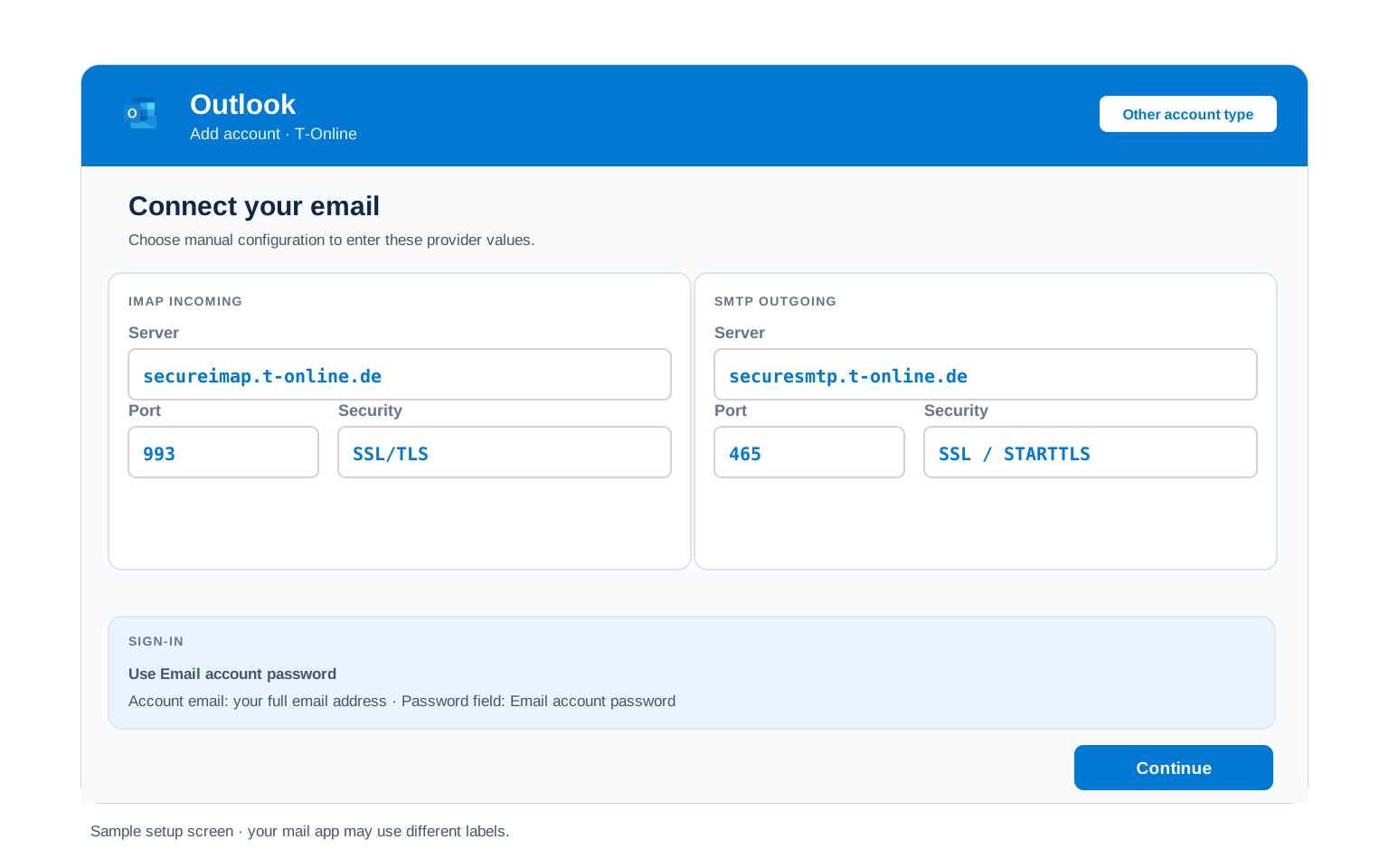
Outlook (Windows and Mac)
- In Outlook choose File, then Add Account. New Outlook keeps it under Settings, then Accounts.
- Enter your T-Online address, open Advanced options and check "Let me set up my account manually".
- Choose IMAP and enter
secureimap.t-online.deon port993with SSL, thensecuresmtp.t-online.deon port465with SSL. - Enter the email program password when Outlook asks, then tick outgoing server authentication under More Settings.
- Mail yourself once it is running. One round trip confirms both directions at once.
Apple Mail (macOS)
- In Apple Mail, take Settings, Accounts, Add Account.
- Choose Other Mail Account. Apple lists no T-Online entry among its providers.
- Enter your name, full address and email program password, then continue.
- Prompted for host names? They sit in the tables further up.
- Keep Mail selected among the offered services, then finish.
iPhone and iPad
- On iOS, follow Settings, Apps, Mail, Mail Accounts, Add Account.
- Tap Other, then Add Mail Account. iOS has no T-Online option built in.
- Enter your details using the email program password, then tap Next.
- Stay on IMAP, supplying both host names where iOS asks.
- Tap Save, giving iOS a moment to check the account.
Android
- Whichever Android mail app you use, pick Add account.
- Select Other, then IMAP, since T-Online is absent from the list.
- Enter your full address and email program password. Where automatic setup fails, switch to Manual setup.
- Enter the servers:
secureimap.t-online.de993 SSL incoming,securesmtp.t-online.de465 SSL outgoing. - Wrap up, then swipe down on the inbox for a first fetch.
Thunderbird
- In Thunderbird, take Account Settings, Account Actions, Add Mail Account.
- Enter your name, full address and email program password, then select Continue.
- Let Thunderbird detect the servers, confirming it chose IMAP.
- Detection unhelpful? Pick Configure manually and enter the values yourself.
- Set the IMAP server directory to
INBOXunder Server Settings, then Advanced. Thunderbird's own German support forum recommends this for T-Online. Without it the folder list can fail to populate properly. Select Done afterwards.
T-Online Webmail Settings#
The values above connect your apps. This next group governs the mailbox itself. It lives in the E-Mail Center in a browser, where your Telekom account password is the one that works.
Signature
Set in the E-Mail Center settings. It applies to mail sent from the browser. Outlook, Thunderbird and Apple Mail each hold their own, which is how people end up with two slightly different versions in circulation.
Vacation Auto Reply
Give the away message a start and an end date so it switches off without you. It runs on Telekom's servers, so replies keep going out with every device of yours turned off.
Filters and Folders
Rules built in the E-Mail Center run server side, filing mail before any device collects it. A rule inside Outlook fires only while Outlook is running, which is why two devices can disagree about where a message went.
Spam and Blocked Senders
Block senders or whole domains from the same settings area. Check the spam folder in the browser first when mail goes missing, since a rule in your client cannot fetch back what the server already filed.
T-Online POP3 vs IMAP#
| Feature | IMAP | POP3 |
|---|---|---|
| Where mail lives | On the T-Online server | Downloaded to 1 device |
| Multiple devices | ✅ Everything stays in sync | ❌ Each device sees different mail |
| Sent and deleted mail | ✅ Synced everywhere | ⚠️ Stays only on that device |
| Offline reading | ⚠️ Cached mail only | ✅ Full local copy |
| Server storage used | Yes, counts against your quota | Can be freed after download |
| Best for | Phone + computer, everyday use | Single PC, local archives |
T-Online Storage and Account Limits#
Telekom publishes storage clearly and stays quiet on sending. Here is what can be established:
| Free mailbox storage | 1 GB on Telekom Freemail, with roughly 3 GB of separate cloud storage |
| Attachment size | Up to 32 MB per message |
| Sending limit, free tier | Up to 100 emails a day and 1,000 a month |
| Folders, free tier | Up to 30 |
| Paid package | Mail M raises storage to 15 GB, drops the advertising, lifts sending to around 5,000 messages per 24 hours and allows up to 100 folders |
| Domain | @t-online.de on free and paid accounts alike |
| Client credential | The email program password, always. Never the Telekom account password |
| Encryption | Required. Unencrypted ports are no longer accepted |
| Who can register | Anyone. Telekom Freemail does not require a Telekom internet contract |
Troubleshooting T-Online Connections#
One cause dominates on T-Online. Start there, then work down.
| Error you see | What it means | Fix |
|---|---|---|
| Login to server secureimap.t-online.de failed | The client is holding your Telekom account password | This is the T-Online error. Your client needs the email program password instead. The account password is correct for the Kundencenter and refused by the mail servers. |
| Connects but folders never appear | Thunderbird needs the IMAP directory set | Under Server Settings, then Advanced, put INBOX in the IMAP server directory field. |
| Worked for years, stopped recently | An old unencrypted configuration | Plain ports 143 and 110 are no longer accepted. Move to 993 and 995 with SSL, keeping the secure hostnames. |
| Cannot connect to server | Wrong port or encryption | Check IMAP 993 SSL and SMTP 465 or 587. Antivirus software and VPN apps block these ports often enough to be worth ruling out. |
| Password keeps being asked | Almost always the wrong one of the two passwords | Replace it with the email program password. Resetting the account password will not help and costs you a browser sign in. |
| Messages stuck in Outbox | SMTP authentication is off | Turn on outgoing authentication, giving it the same credentials as incoming. |
Reader Reported Fixes
Changing the account password and expecting mail to follow. This is the loop people get stuck in. The client rejects the password, so they reset their Telekom password, which changes the browser credential and leaves the email program password untouched. The client rejects it again. Round it goes. The two passwords are independent. Only the second one reaches the mail servers.
Assuming a German language guide describes something different. Telekom Mail, T-Online and the E-Mail Center all name parts of one service. German guides discussing the "Passwort für E-Mail-Programme" are describing exactly the credential this page calls the email program password. If the German instructions look more thorough than the English ones, that is because they usually are.
Telekom Mail, T-Online and Moving Your Mail#
Reading about Telekom Mail rather than T-Online? They are the same service. Telekom applied the new name in 2013 and the @t-online.de address stayed put, so guides using either name describe the same mailbox on the same servers.
Moving mail off T-Online? A migration tool connects over IMAP like any client, so it needs the email program password rather than your account one. That single detail accounts for most failed T-Online migrations.
Leaving Telekom entirely? A t-online.de address is tied to the Telekom relationship, so back the mailbox up before you cancel. Even a 1 GB mailbox is a lot to move one message at a time through a browser.
Taking your mail to a new account? The Univik Email Migration Tool copies every folder from the old account to the new one. Enter the IMAP settings from this page for the T-Online side and your new provider's settings for the other.
Rather not do it yourself? The Email Migration Services team designs the move, performs it, then checks every folder arrived.
Use These Settings in Univik Email Backup#
The same IMAP settings above let you download your complete T-Online mailbox to your computer. Univik Email Backup writes the mailbox into PST, MBOX, EML or PDF. Those files stay yours whatever happens to the Telekom account.
- Install Univik Email Backup on a Windows PC.
- Choose T-Online as the source. Not there by name? Generic IMAP behaves identically.
- Sign in with your full email address and the email program password. A backup tool is an IMAP client, so the account password is refused here as well.
- If the tool asks for server details, use
secureimap.t-online.dewith port993and SSL from the IMAP table above. - Choose the file format and where it lands, then run it. Years of mail work through unattended.
Univik Tools That Use These Settings#
A fair number of readers are mid move or mid archive. Each of these 3 tools uses the IMAP values above:

Email Backup
Download your complete T-Online mailbox to PST, MBOX, EML or PDF before switching or closing the account.
Email Backup Tool →
Email Migration Tool
Copy every folder from T-Online straight into Gmail, Microsoft 365 or any other account. No manual export needed.
Email Migration Tool →
Email Converter Tool
Holding MBOX, EML or OST from a previous export? Turn it into PST, PDF or whatever your next app reads.
Email Converter Tool →Prefer to hand the whole migration to experts?
There is no need to become fluent in two password schemes under time pressure. The Univik migration team owns the job throughout, scoping, transferring, verifying, then supplying a report of where every folder ended up. Running since 2013, from one mailbox to an entire organisation.
Email Settings Glossary#
IMAP
Internet Message Access Protocol. Reads mail held on the server, keeping folders and read marks aligned across devices.
POP3
Post Office Protocol version 3. Downloads mail to 1 device and can remove it from the server. Older method, still useful for local archives.
SMTP
Simple Mail Transfer Protocol. Sends your outgoing mail. Every account needs it next to IMAP or POP3, which only receive.
SSL / TLS / STARTTLS
Encryption for the connection. SSL/TLS encrypts from the start (ports 993, 995, 465). STARTTLS upgrades a plain connection (port 587).
App Password
A separate credential standing in for your real password inside an app. Telekom's version is the password for email programs, which you set yourself rather than receiving as a generated code.
OAuth
Signing in through a browser window rather than typing a password into the app. Several large providers have moved this way. Telekom solves the same problem with its second password instead.
How We Verify These Settings#
Univik has built email backup, migration and converter software since 2013. Our tools sign in to T-Online over IMAP and SMTP every day for thousands of users, so a changed server, port or login rule shows up in our connection logs before most guides notice it.
Every value on this page is confirmed with 3 checks: a live IMAP and SMTP connection from Univik Email Backup, a comparison against Telekom's own published help pages and a sign in run through the current E-Mail Center. Any announcement triggers a recheck. We revisit the page quarterly regardless.
Page disagreeing with your screen? Let us know. We retest, amend it, then log the change in what changed recently.
 Help & Support
Frequently Asked Questions
Use secureimap.t-online.de on port 993 with SSL/TLS, with your full t-online.de address as the username. The password has to be the email program password rather than the one that opens your Kundencenter. The complete table sits in the IMAP settings section.
Because Telekom keeps two passwords and your client almost certainly has the wrong one. The account password opens the Kundencenter and the E-Mail Center in a browser. Mail clients need the separate password for email programs, set in the Kundencenter. Retyping the account password will never work, however carefully you type it.
IMAP for almost everyone. It keeps your phone, computer and webmail in sync. POP3 fits only a single computer setup where you want a local download. Full comparison here.
Yes. That holds on free and paid accounts alike. The paid Mail M package uses the same hosts as a free Freemail mailbox. Only the menu names differ by device, which the client setup guides cover. Thunderbird has one extra step worth knowing about.
Telekom's works differently from most. Because you set the email program password yourself rather than receiving a generated code, you can view and change it again in the Kundencenter. That is more forgiving than the write-it-down-immediately model elsewhere.
Yes. The two password design is the reason. Your mail client holds a credential that reaches the mailbox and nothing else, so a compromised client cannot touch your wider Telekom account. Connections run encrypted throughout, since unencrypted ports are no longer accepted.
An IMAP client pulls mail down as it syncs, though a dedicated backup tool moves faster and writes standard files that open anywhere. With only 1 GB on the free tier, a full mailbox fills sooner than people expect, which makes archiving worth doing properly. See how to back up your T-Online mailbox. Left with an export in an awkward format? An email converter turns it into PST, PDF or whatever comes next.
Two likely causes on T-Online. Either the email program password was changed while the device still holds the old one. Or the setup predates the move to encrypted ports and still points at 143 or 110. Neither is a fault in your client. See what changed recently.
An email migration tool copies mail directly between the 2 accounts over IMAP. You need the T-Online IMAP settings and the email program password for this side, plus the same details for the destination account. Every folder, label and date stays intact.
High stakes? A stack of mailboxes? Our managed email migration service takes on the whole thing.
Other Email Provider Settings
Summary: T-Online Settings at a Glance
- IMAP: secureimap.t-online.de, port 993, SSL/TLS
- POP3: securepop.t-online.de, port 995, SSL/TLS
- SMTP: securesmtp.t-online.de, port 465 or 587
- Username is always your full email address
- Use the email program password
- Never the Kundencenter password
- Every host starts with secure
- Thunderbird: set IMAP directory to INBOX